How Municipal Drinking Water Systems WorkFrom the River or Well to Your Kitchen Tap
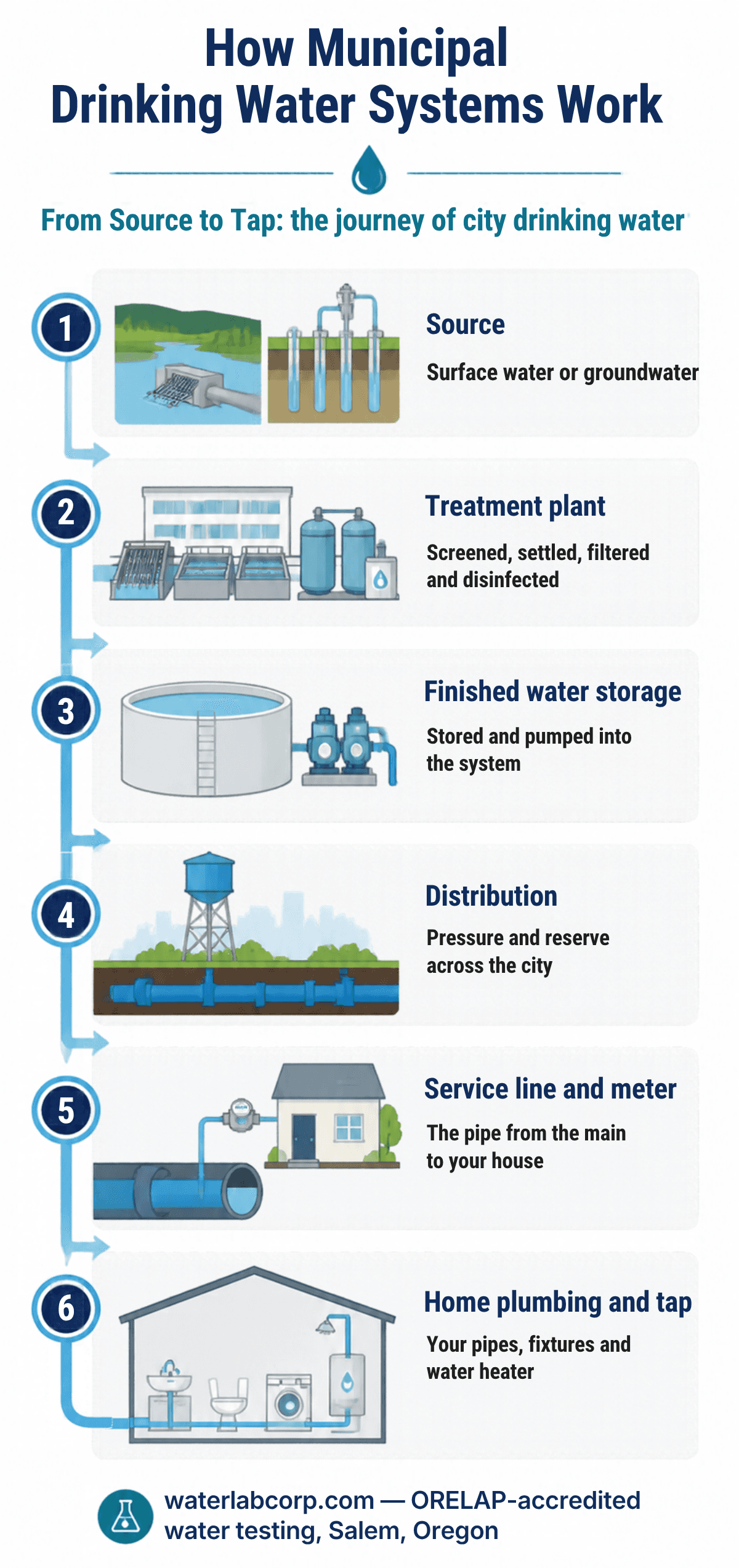
Turn on a faucet in Salem and the water has already made a trip of a day or more: pulled from a river or an aquifer, treated, stored, pumped under every street in town, and pushed through a small pipe into your house. Here is each stage of that trip, what can go wrong along the way, and why the last hundred feet matter most to what ends up in your glass.
11 min read · Waterlab Corp Laboratory Staff
Where city water starts
Every public water system begins with a source, and the source decides almost everything about the treatment that follows. There are two kinds. Surface water is taken from a river, a lake, or a reservoir through an intake structure, usually a screened tower or a pipe set below the low-water line. Groundwater is pumped from a field of deep wells drilled into an aquifer, the same way a private well works but at a much larger scale.
Surface water is open to the sky. Rain washes soil, fertilizer, animal waste, and road grime into it, algae bloom in it during warm months, and wildfire or a reservoir drawdown can load it with sediment overnight. Groundwater has spent years or decades moving through soil and rock that strained most of that out, which is why a well system can often skip filtration entirely. The trade-off is that groundwater picks up whatever the rock is made of: arsenic, iron, manganese, hardness, and in farm country, nitrate.
Surface water
Rivers, lakes, and reservoirs. Plentiful and close to the surface, but exposed to runoff, algae, wildfire ash, sediment, and whatever lives upstream. Surface water almost always needs full filtration and disinfection.
In Oregon: Salem draws from the North Santiam River. Eugene draws from the McKenzie. Portland draws from the Bull Run watershed.
Groundwater
Wells drilled into an aquifer, often several hundred feet deep. Soil and rock have already filtered the water, so it is usually clear and biologically stable, but it can carry naturally occurring arsenic, iron, manganese, nitrate, or hardness.
In Oregon: Many Willamette Valley and Central Oregon towns run entirely on well fields, sometimes blending several wells to even out quality.
A local example: Salem
Salem's water comes from the North Santiam River, drawn at Geren Island near Stayton. The city uses slow sand filtration, which relies on a living biological layer on top of the sand rather than chemical coagulation. After the 2018 cyanotoxin advisory, when algae toxins from Detroit Reservoir reached the intake, Salem added ozone treatment ahead of the filters. The river is also why a reservoir drawdown upstream is a drinking-water story and not just a fish story; our guide to the Detroit Dam drawdown explains what that sediment means for the towns along the river.
Inside the treatment plant
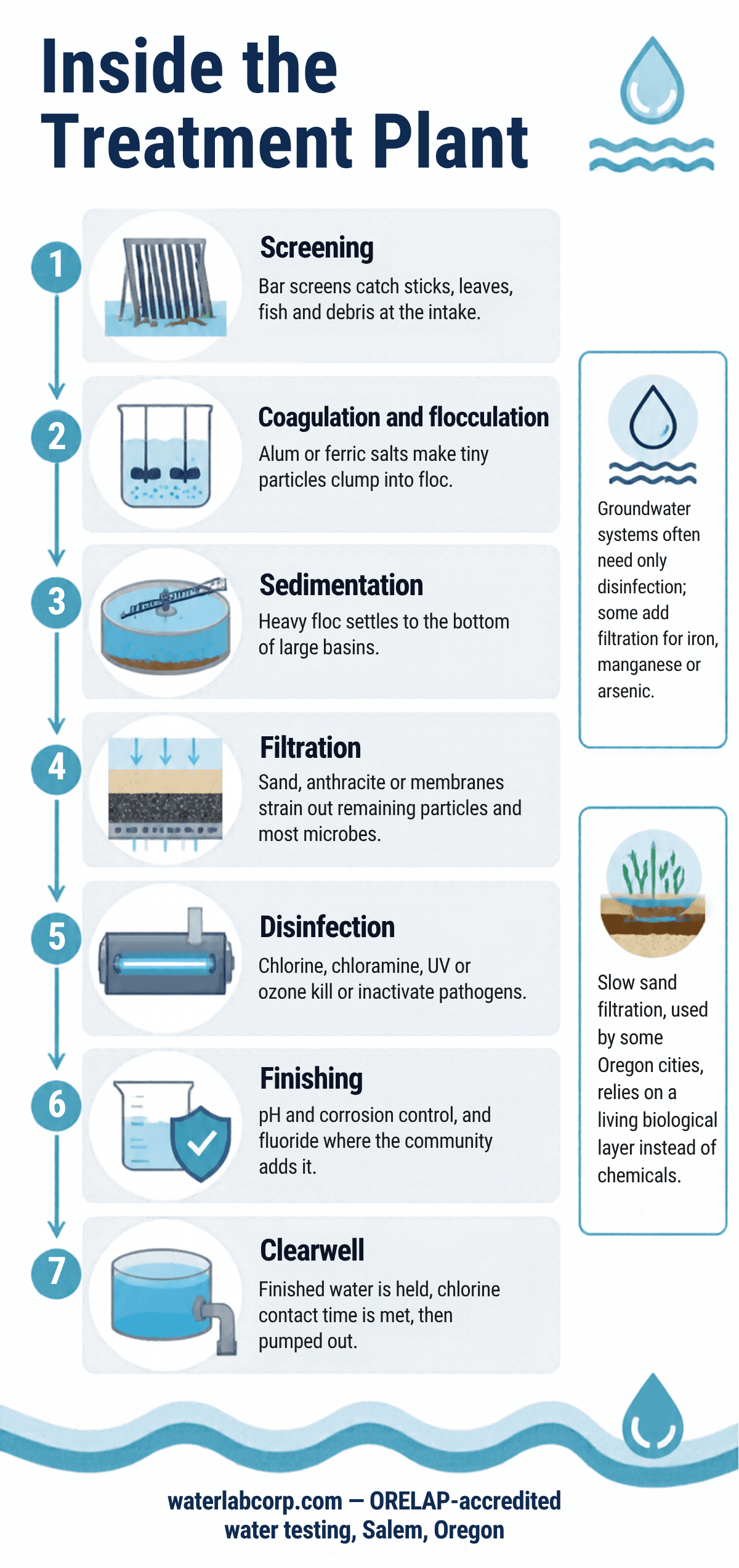
A conventional surface-water plant is a sequence of physical and chemical steps, each one removing what the previous step could not. Nothing about it is exotic. It is settling, straining, and disinfecting, done at a scale of millions of gallons a day with constant measurement.
Screening
Coarse bar screens at the intake stop sticks, leaves, fish, and trash. Finer screens catch smaller debris before it reaches the plant.
Coagulation and flocculation
A coagulant such as aluminum sulfate or ferric chloride neutralizes the electrical charge on tiny suspended particles. Gentle mixing then lets them collide and clump into larger, heavier flocs.
Sedimentation
Water moves slowly through large basins so the floc settles to the floor as sludge. Most of the turbidity, and a good share of the microbes attached to it, leaves the water here.
Filtration
Water passes through beds of sand and anthracite, or through membranes, to strain out the remaining particles and most protozoa like Giardia and Cryptosporidium. Filters are backwashed regularly to clean them.
Disinfection
Chlorine, chloramine, ozone, or ultraviolet light kill or inactivate bacteria and viruses. Chlorine and chloramine also leave a residual that keeps protecting the water in the pipes.
Finishing
Operators adjust pH and alkalinity and may add a corrosion inhibitor so the water does not dissolve lead and copper from pipes. Communities that fluoridate add fluoride at this stage.
Clearwell
Finished water is held in a large covered tank. This gives the disinfectant the contact time it needs and provides a buffer so pumps can run steadily even as demand swings.
Three things worth knowing about disinfection
Chlorine versus chloramine. Free chlorine is the classic disinfectant and works fast. Chloramine, made by adding a little ammonia to chlorine, is weaker but lasts longer in the pipes and forms fewer byproducts, so larger systems with long pipe networks often use it. It matters to aquarium owners and dialysis patients, and it changes which home filters work.
Disinfection byproducts. When chlorine meets natural organic matter it forms trihalomethanes and haloacetic acids. They are regulated, and removing organic matter before disinfection is one of the main reasons plants bother with coagulation and filtration at all. Water that has aged longest in the system carries the most, which is why utilities sample at the far ends.
Groundwater systems. A well system with clean, stable groundwater may do nothing but add chlorine and adjust pH. If the aquifer carries iron and manganese, the plant oxidizes and filters them. If it carries arsenic, as many Willamette Valley and Central Oregon aquifers do, it needs adsorption or coagulation-filtration designed for that one contaminant.
Storage and distribution: getting it across town
Treatment ends at the clearwell. From there the problem is mechanical: keep enough water, at the right pressure, moving through hundreds of miles of buried pipe, and keep it clean while it travels. Water can take hours in a small town or more than a week in a large one to reach the farthest tap.
Why towns have water towers
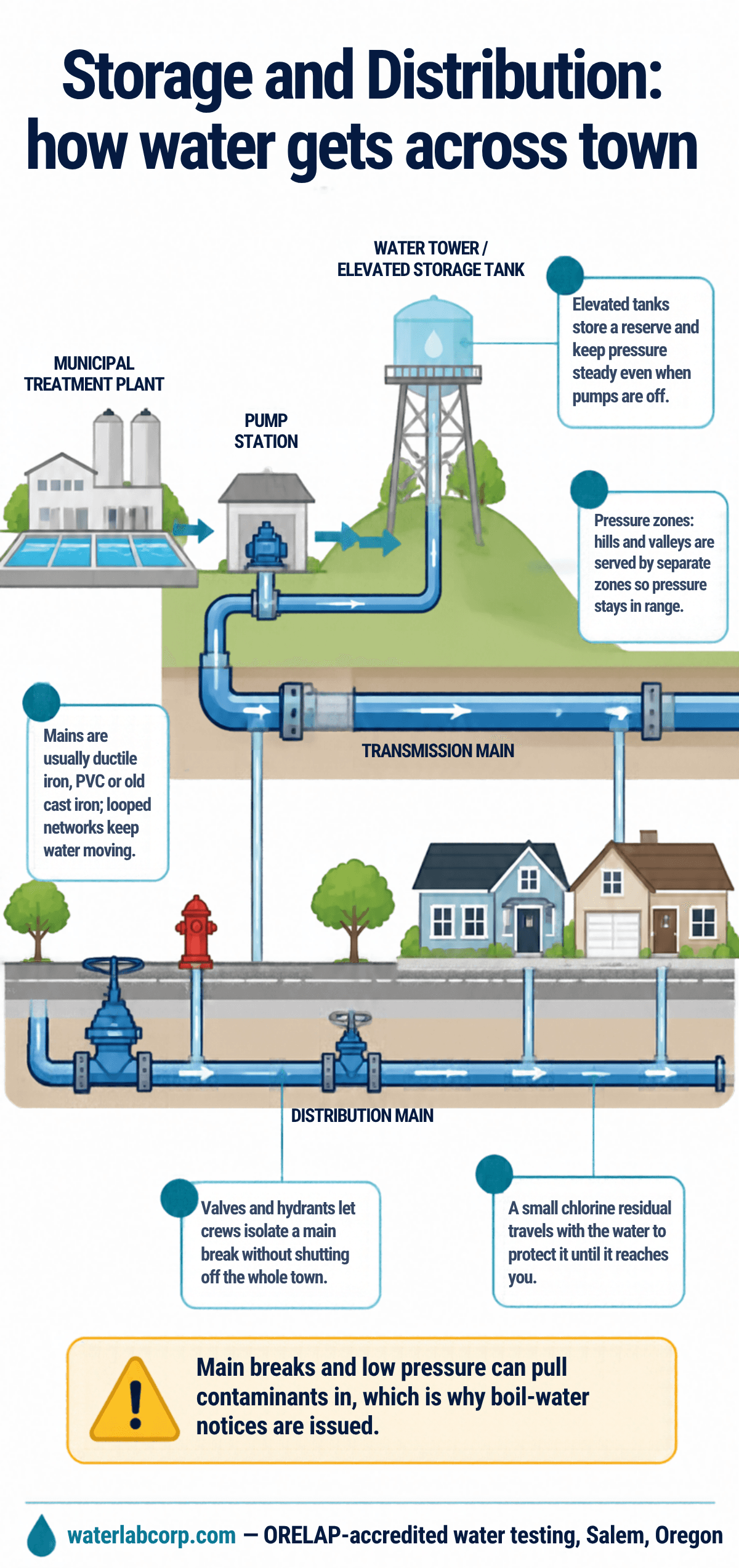
An elevated tank does two jobs. Its height creates pressure by gravity, so pressure holds even if a pump fails or the power goes out. Its volume is a reserve for peak morning demand and for firefighting.
Pressure zones
Water pressure depends on elevation. A hillside neighborhood and a valley neighborhood cannot share one tank without one of them getting too much or too little, so systems are split into zones with their own tanks, pumps, and pressure-reducing valves.
What the mains are made of
Large transmission mains carry water from the plant; smaller distribution mains run under every street. Newer pipe is ductile iron or PVC. Older cast iron and asbestos-cement mains are still common, and cast iron builds up tuberculation that can shed rust and color.
Loops, valves, and hydrants
Mains are laid out in loops rather than dead ends so water keeps moving and any street can be fed from two directions. Valves let crews isolate a single block for a repair. Hydrants are for firefighting, but crews also open them to flush stale water.
The residual that rides along
Water leaves the plant with a small, measured amount of chlorine or chloramine. It reacts with anything it meets in the pipes, so operators test the residual across the system to be sure it has not run out before reaching the last customer.
Main breaks and boil notices
When a main breaks or pressure drops, groundwater and soil can be pulled into the pipe. That is why a boil-water notice follows a break: the water was safe when it left the plant, but the pipe was briefly open to the ground.
Cross-connections and backflow
The distribution system is only safe while pressure pushes outward. A garden hose left in a bucket of pesticide, an irrigation system, or a boiler connected to the supply can siphon backward into the mains the moment pressure drops. That is why utilities require backflow preventers on irrigation and commercial connections, and why they test them every year.
The last hundred feet: from the main to your tap
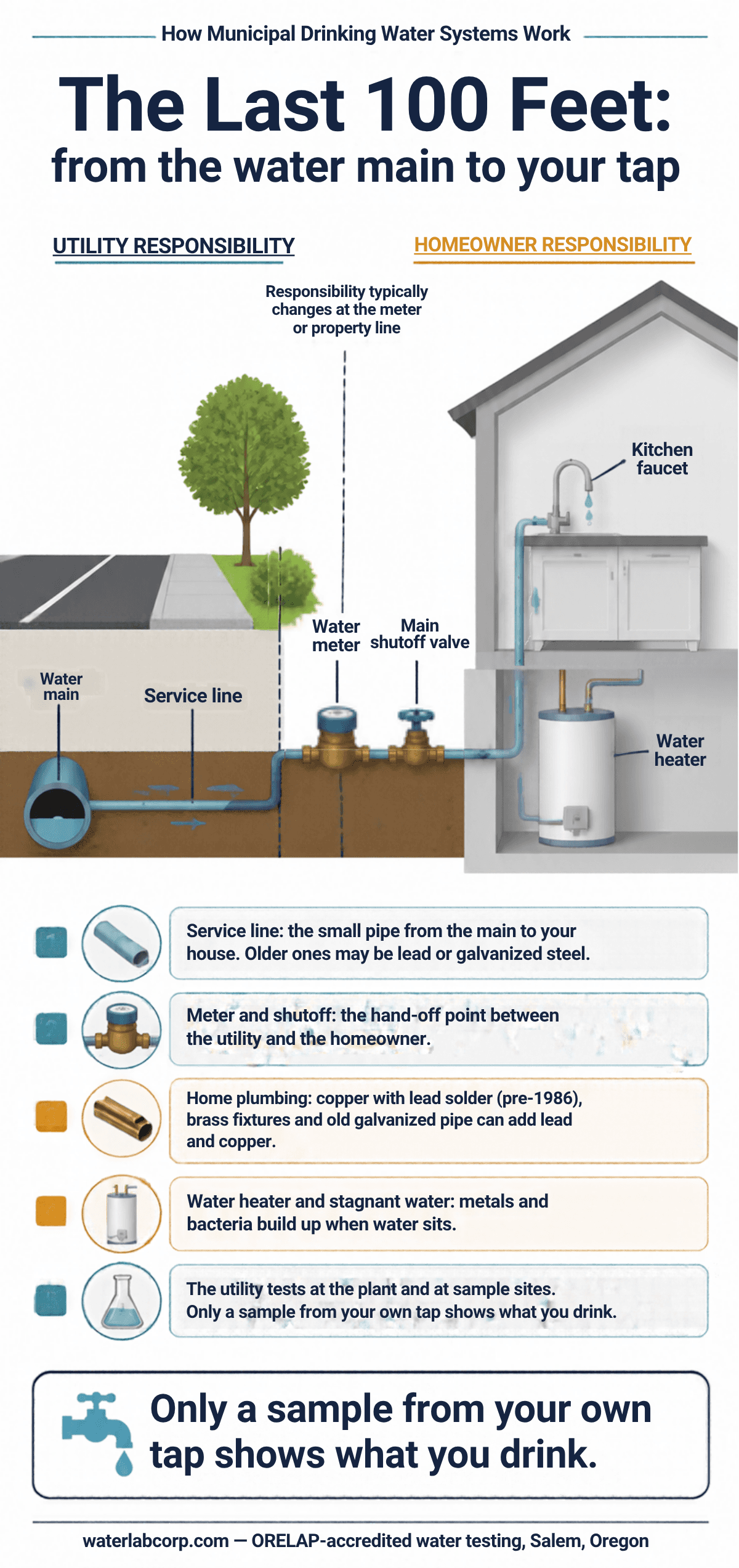
Everything up to this point is the utility's system, treated and monitored. The service line and your own plumbing are not. Water that was excellent at the main can pick up lead, copper, iron, and bacteria in the last few dozen feet, and this stretch is where most tap-water complaints in a city home actually come from.
The service line
A small pipe, usually three-quarters of an inch to one inch, that tees off the main and runs to your house. Depending on the era, it may be copper, plastic, galvanized steel, or in older neighborhoods lead. Utilities are now required to inventory service line materials and tell customers what they have.
The meter and shutoff
The meter is usually the hand-off point. The utility owns and maintains the pipe up to the meter or property line; everything on the house side is the owner’s responsibility, including replacing an old service line on that side.
Your plumbing
Copper pipe joined with lead solder was standard before 1986. Brass faucets and valves made before 2014 could contain up to 8% lead. Galvanized steel pipe corrodes from the inside and traps lead that passed through earlier. PEX and modern copper add very little.
Water heaters and stagnation
Water that sits overnight in pipes and fixtures picks up more metal than water that is flowing. Sediment collects in the bottom of water heaters. That is why lead and copper tests use a first-draw sample after the water has been still for several hours.
Why corrosion control at the plant is not the whole answer
Utilities adjust the water's chemistry so it forms a protective scale inside pipes instead of dissolving them. It works, and it is the reason most old homes on city water do not have a lead problem. But it is a system-wide setting tuned to average conditions. A home with a lead service line, a long run of galvanized pipe, or a fixture that sits unused for days can still deliver metal at the tap. Our guide to lead in Oregon drinking water covers how to tell, and what a first-draw sample is.
Who tests the water, and where
Public water systems in Oregon are regulated under the federal Safe Drinking Water Act and overseen by the Oregon Health Authority's Drinking Water Services. The monitoring is real and extensive, and every compliance sample has to be analyzed by an accredited laboratory. It just stops at the edge of the system.
What the utility must test
- Coliform bacteria at sample taps across the system every month, under the Revised Total Coliform Rule.
- Disinfectant residual, turbidity, and treatment performance continuously or daily at the plant.
- Disinfection byproducts (trihalomethanes and haloacetic acids) at points where water has aged the longest.
- Lead and copper at a small set of customer taps on a schedule, under the Lead and Copper Rule.
- Inorganics, nitrate, radionuclides, volatile and synthetic organics, and PFAS on multi-year cycles.
What the utility cannot see
- Your service line, especially the portion on your side of the meter.
- Lead solder, brass fixtures, or galvanized pipe inside your home.
- Water that has sat in your plumbing overnight or while you were away.
- Bacteria introduced by a cross-connection, a backflow event, or a repair on your property.
- Anything that happens after a main break on your street until the lines are flushed.
Reading your Consumer Confidence Report
Every community water system publishes an annual water quality report, often called a Consumer Confidence Report, by July 1. It lists the source, each regulated contaminant that was detected, the level found, the legal limit, and any violations. It is worth reading. Just remember that the lead and copper line reflects a handful of sampled homes, and every other number was measured before the water reached your service line.
When a sample from your own tap makes sense
- Your home was built before 1986, or you are not sure when the plumbing was last replaced.
- An infant, a pregnant person, or someone with a weakened immune system drinks the water.
- The water is discolored, cloudy, or has a metallic or chemical taste, especially first thing in the morning.
- There has been a main break, a boil-water notice, or construction on your street.
- Your utility’s service line inventory lists your line as lead, galvanized, or unknown.
- You simply want a number for your own tap rather than a system-wide average.
Related reading: what is in Oregon tap water, do I need to test my drinking water, and how to collect a sample.
On city water and want to know what reaches your tap?
A lead and copper first-draw test is the usual starting point. We also run compliance monitoring for public water systems across Oregon.