
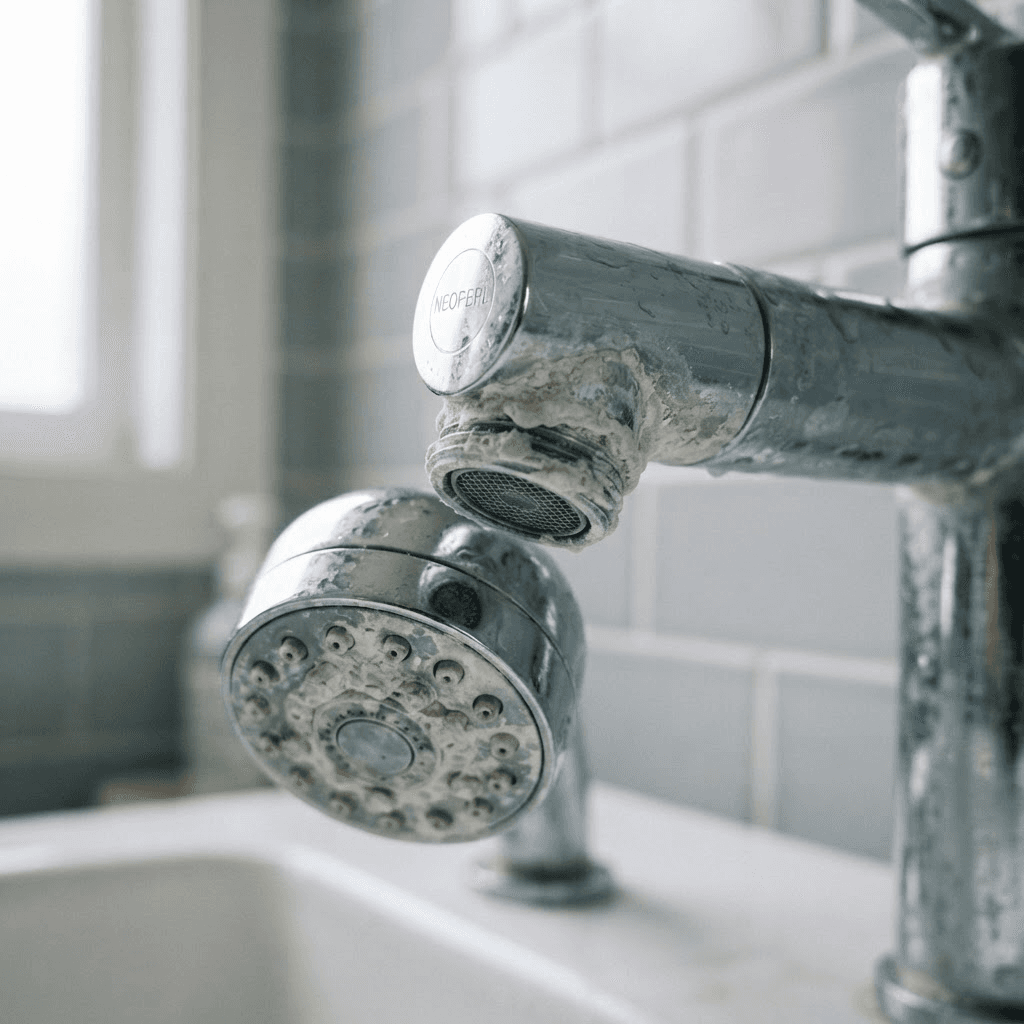
Faucets & showerheads
White crust around the tip, clogged aerators, weaker spray, and drips that come back soon after you replace a washer.
If you fight white crust on your faucets, cloudy glasses, or an ice maker that keeps quitting, you probably have hard water. Here is what “hard” actually means, how calcium and TDS fit in, and how a simple test tells you what to do about it.
8 min read · Waterlab Corp Laboratory Staff
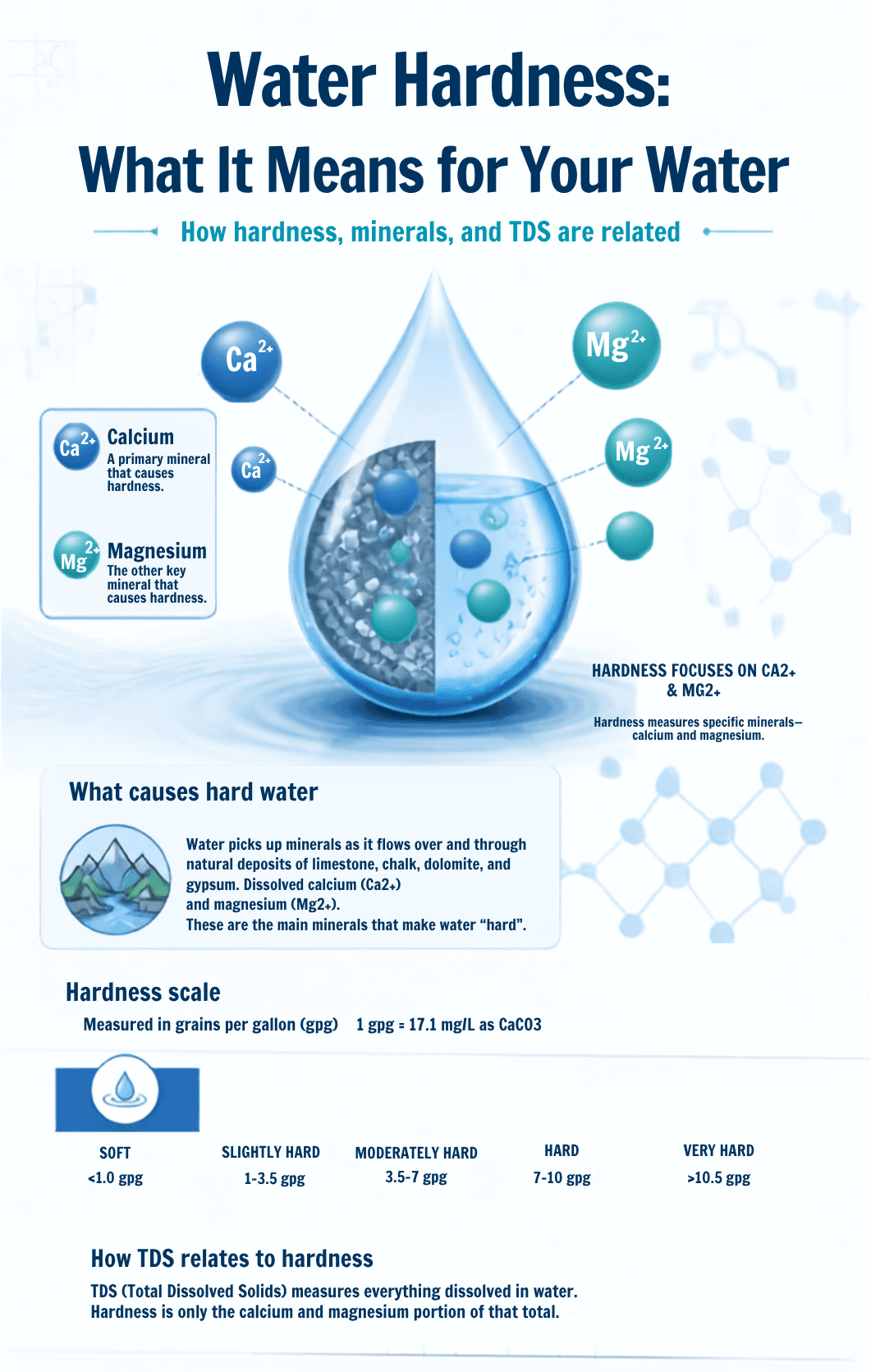
Water is a natural solvent. As rain soaks into the ground and moves through soil and rock, it slowly dissolves minerals along the way. Two of those minerals—calcium and magnesium—are what make water “hard.”
Water hardness is simply a measure of how much dissolved calcium and magnesium your water is carrying. That is the whole idea: hardness is not dirt, and it is not a sign the water is unsafe. It is a count of dissolved rock minerals.
Water that has spent a long time underground in limestone or mineral-rich soil tends to pick up more of them, which is why well water and groundwater are often harder than surface water. The more calcium and magnesium in the water, the harder it is—and the more of that chalky white residue it leaves behind on everything it touches.
Labs usually report hardness in milligrams per liter (mg/L) as calcium carbonate. Water-treatment pros often use grains per gallon (gpg) instead.
To convert between them: 1 gpg ≈ 17.1 mg/L.
The scale below is the standard used by the U.S. Geological Survey to describe how hard water is.
0–17
Soft
<1
17–60
Slightly Hard
1–3.5
60–120
Moderately Hard
3.5–7
120–180
Hard
7–10
> 180
Very Hard
> 10
Grains per gallon (gpg)
Most households that notice scale, spotting, or soap that will not lather fall in the “hard” or “very hard” range. A test tells you exactly where you land.
Calcium and magnesium together create hardness, but calcium is usually the larger share. That is why you may see two different numbers on a water report: a calcium result and a total hardness result. Calcium measures just the calcium. Total hardness rolls calcium and magnesium into one combined number, converted to a common calcium-carbonate scale so it can be compared easily.
So calcium adds to hardness—it is a big piece of it—but it is not the entire measurement. If your calcium is high, your hardness will be high too. Knowing both is useful because some treatment choices depend on the ratio of calcium to magnesium, not just the total.
Total dissolved solids (TDS) is the broadest of the three numbers. It estimates everything dissolved in your water added together: the calcium and magnesium that make it hard, plus sodium, potassium, chloride, sulfate, bicarbonate, and other dissolved substances. Think of TDS as the grand total, and hardness as one important slice of that total.
Because hardness minerals are part of TDS, the two usually rise and fall together—harder water is generally higher in TDS. But they answer different questions. Hardness tells you specifically how much scale-forming calcium and magnesium you have. TDS only tells you how much dissolved material is present overall, not what it is. Two samples can have the exact same TDS reading and completely different chemistry—one loaded with hardness minerals, another with sodium and chloride.
This is the catch with the inexpensive handheld “TDS pens” sold online. They are fine for spotting a trend or a sudden change in a water source, but they cannot tell hardness minerals apart from anything else, and they cannot flag a health-related contaminant. When you need to know what is actually in the water, that takes a laboratory test.
Here is the part that connects the chemistry to your plumbing. Dissolved hardness minerals stay invisible in cool, pressurized water—but when that water is heated, loses pressure, or evaporates, the minerals fall out of solution and harden into that pale, chalky crust called scale. That is exactly why the trouble almost always starts on the hot side of your home: water heaters, the hot tap, showerheads, kettles, and any surface where droplets sit and dry.
Scale is stubborn. A thin coating on a valve or washer can keep it from sealing, so a faucet drips again a week after you replaced the part. In a refrigerator or ice maker, deposits build up in the tiny inlet valve and thin fill line, which shows up as slow fill, hollow cubes, or a machine that jams. Hardness is not the only thing that can cause these problems—but when scale keeps coming back, it is a strong clue that your water is the reason.
How to spot it around the house
If you recognize several of these at once—especially on anything that heats water—hardness is very likely the common thread.
White crust around the tip, clogged aerators, weaker spray, and drips that come back soon after you replace a washer.
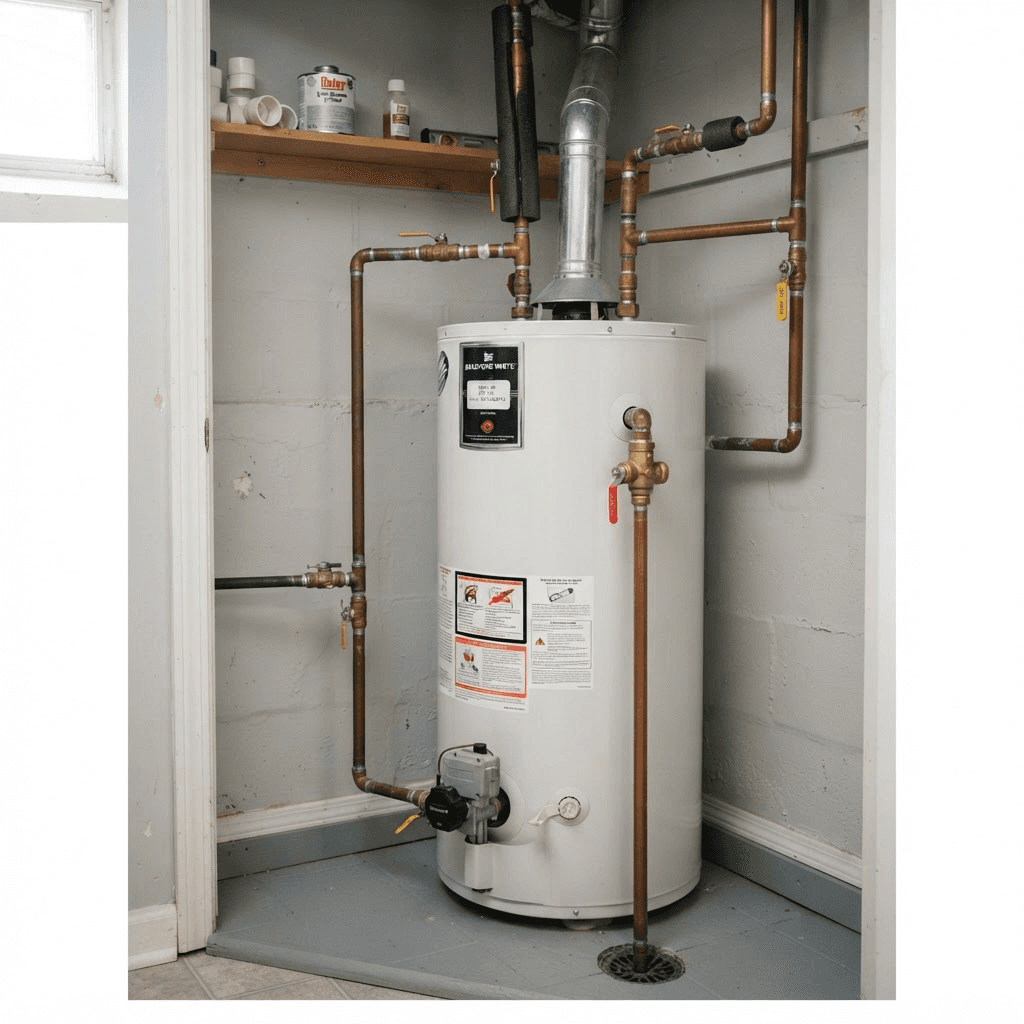
A layer of scale settles on the heating surface, which can cause popping or rumbling sounds, slower reheating, and higher energy use.
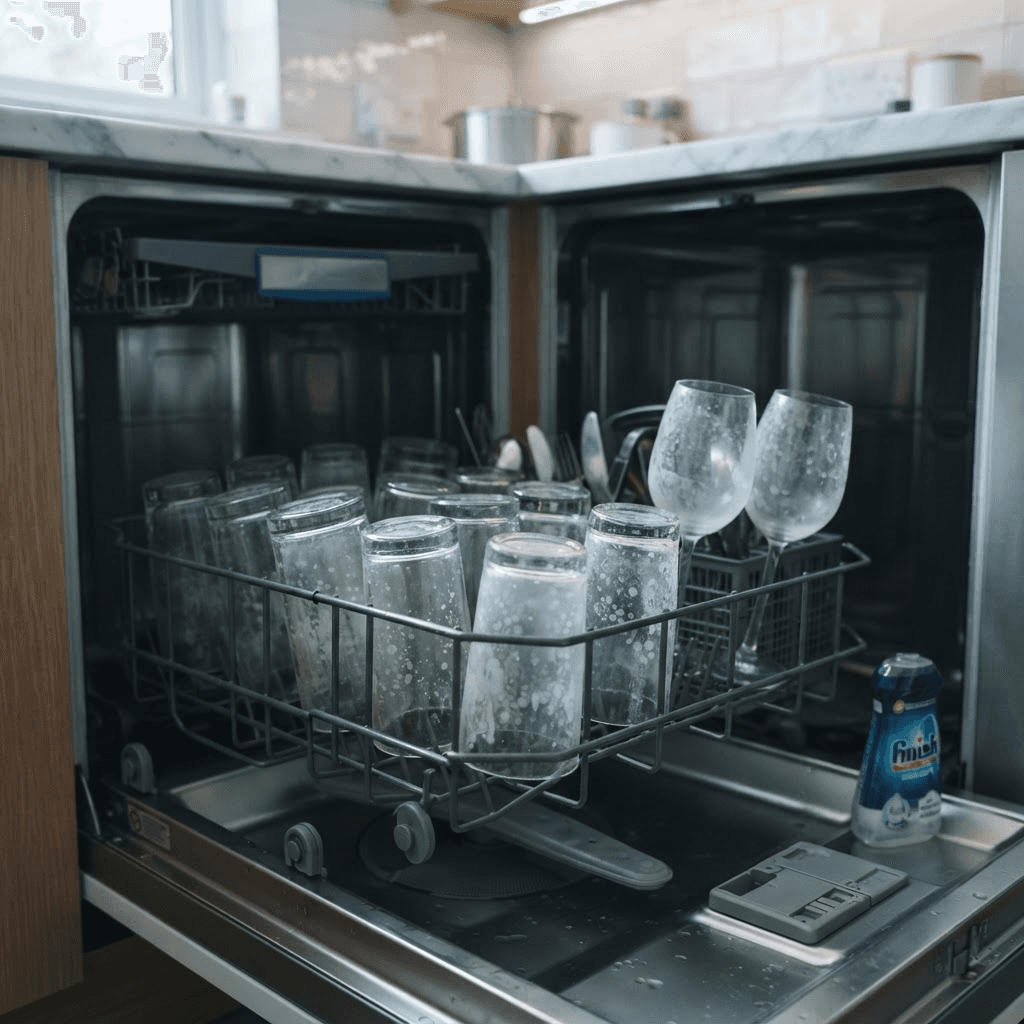
Spotty, cloudy glassware and a chalky film on the tub, spray arms, and heating element even when detergent is working.
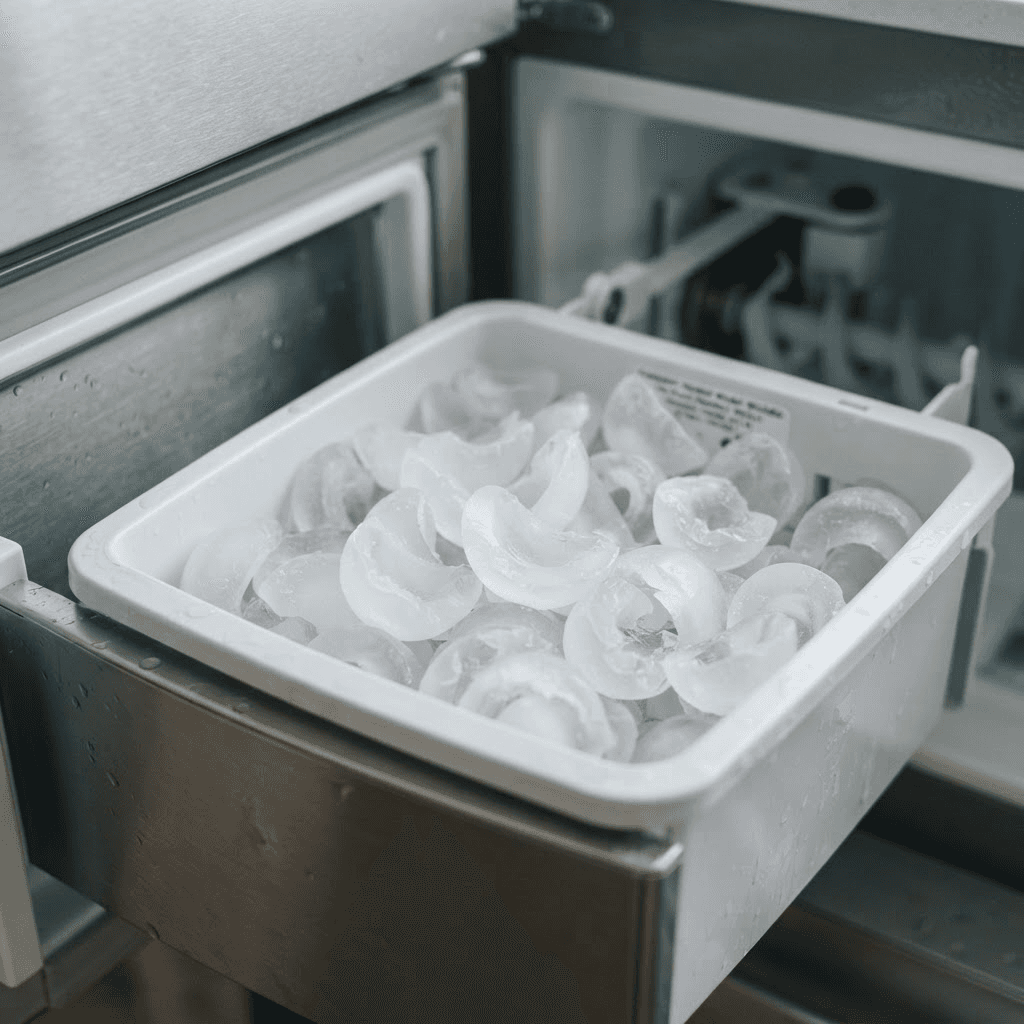
The small inlet valve and narrow fill line scale up easily, which shows up as slow fill, hollow or cloudy cubes, or an ice maker that jams.
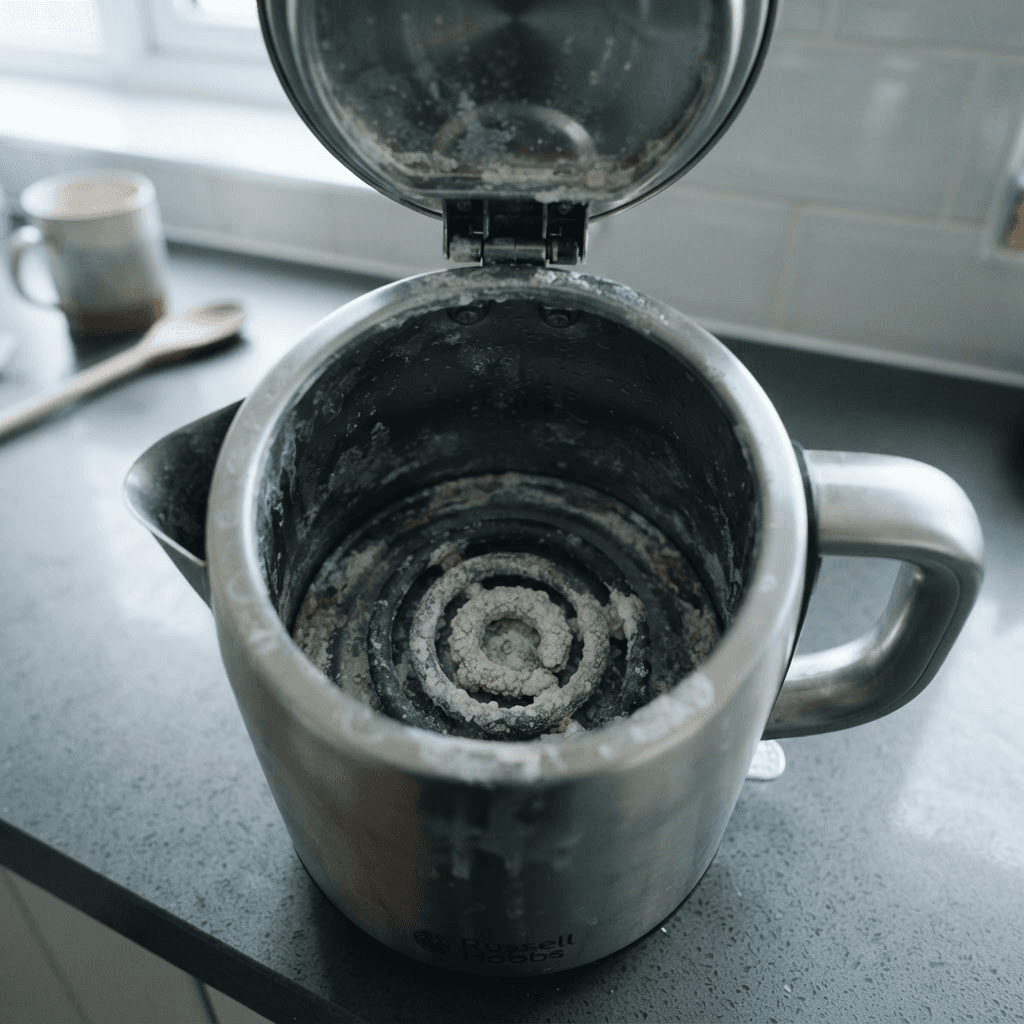
Kettles, coffee makers, humidifiers, and steam irons show deposits first because they repeatedly heat and evaporate the same water.
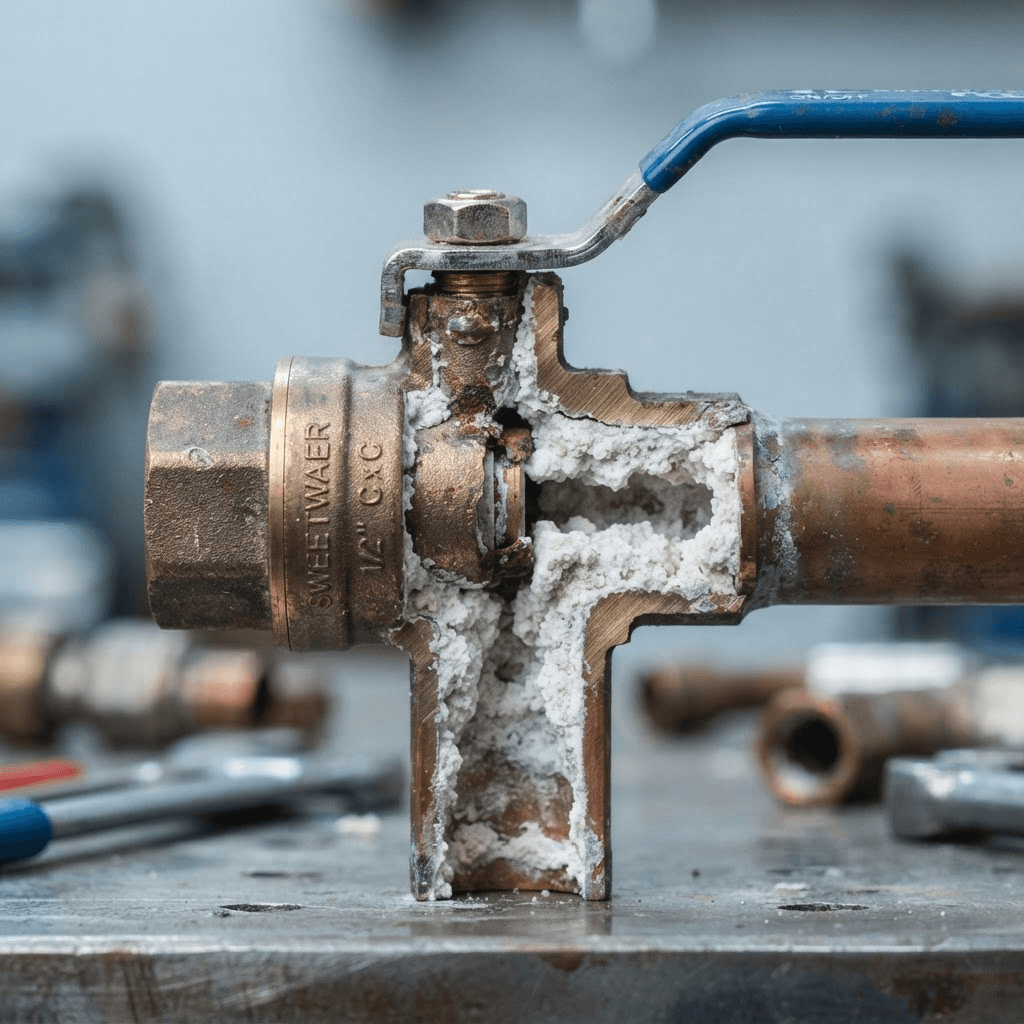
Over years, scale narrows pipe openings and coats cartridges, check valves, and pressure controls, so parts wear out or stick.
Cleaning and descaling gets things working again in the short term, but if the scale keeps returning, the fix is to treat the water—and to treat it based on what a test shows, not a guess. A lab mineral panel breaks out your total hardness, calcium, and other dissolved constituents so you know how hard your water is and what is driving it.
Seeing more than white scale? Our water-stain field guide compares red, black, green, and blue-green marks too.
That number decides the equipment. A conventional ion-exchange water softener is built to remove calcium and magnesium—the hardness—and it is sized to your specific hardness level. It is worth knowing what a softener does not do: it is not a whole-home purifier. It swaps out hardness minerals but does not remove every contaminant or bring down all of your TDS. If you are also concerned about taste or a specific contaminant, that may call for a different or additional treatment, which is another reason the test comes first.
In short: spot the pattern, test the water, then choose the treatment. Testing first means you buy the right system once and can confirm it is working with a follow-up test.
If you keep scraping white scale off faucets, replacing the same faucet parts, hearing a water heater rumble, or babysitting a temperamental ice maker, a hardness and mineral test will tell you whether your water is the cause. We can talk through your water source and point you to the right testing panel.
Want the bigger picture of local water first? See What's in Oregon Tap Water? or our step-by-step drinking water testing guide.
A quick call is the fastest way to figure out the right test for your home.